
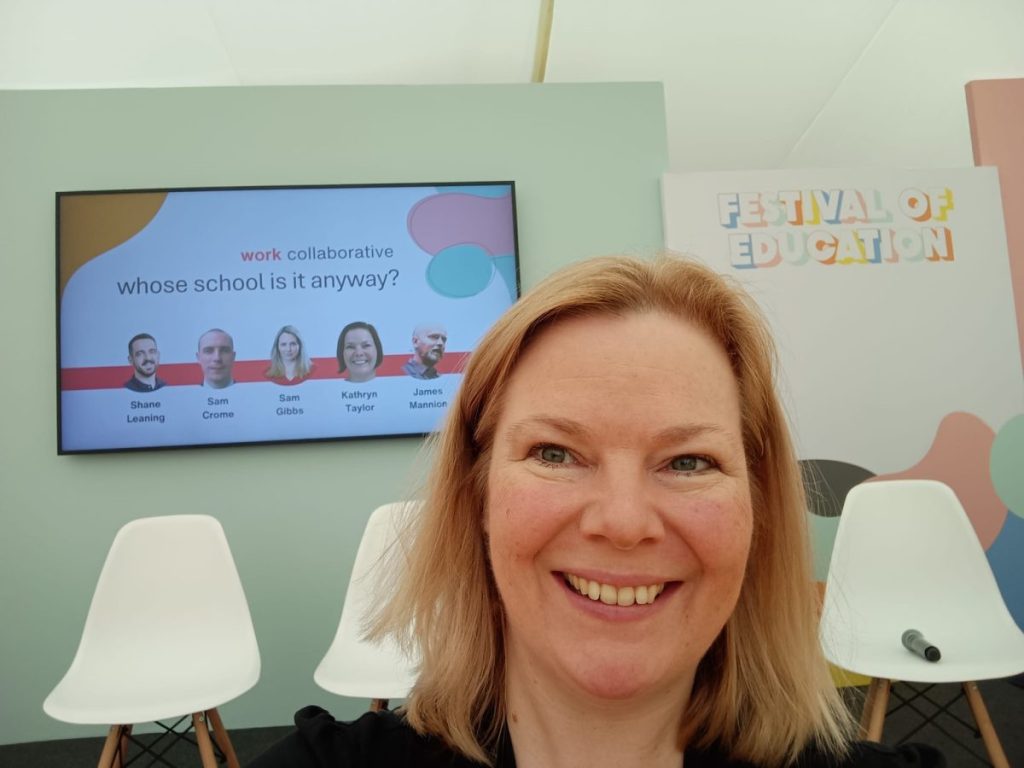
Last week I had the absolute pleasure of attending the Festival of Education at Wellington College.
It was such an honour to be invited by Shane Leaning to contribute to a panel discussion about teacher professional development and learning, and school cultures. I was sharing the stage with some real heavyweights in the field, too, Dr James Manion, Sam Crome and Sam Gibbs, and, of course, Shane himself.
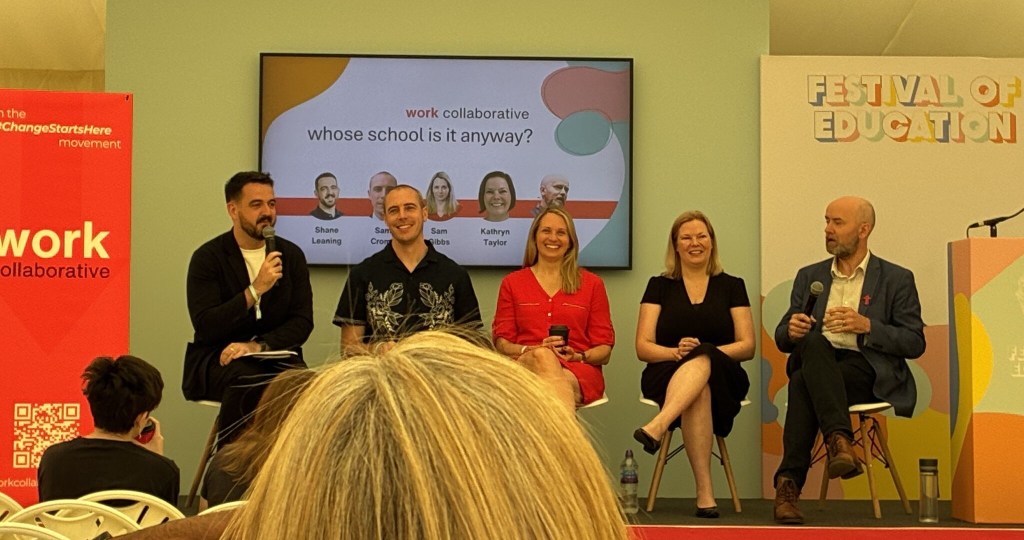
Image credit: With thanks to Chris Scorer
It is always interesting presenting at these kinds of events – in some ways you think, “What do I know?”, or, “Who is even interested in what I know?”
What I do know is this: We have a serious and urgent teacher recruitment and retention issue in education. It isn’t just here, but in all sorts of places around the world. It has been creeping in for several years and now it is biting, hard.
The professional learning pipeline is dysfunctional. This is a very serious issue because it means that the latest good stiff (assuming we can identify it and agree on what it is, which is another pressing question) often doesn’t make it into the classroom, so the students don’t get the benefit.
We can’t just blame cynical, grumpy, change-resistant teachers. I’m sure they exist, but I argue that CPD resistance is a symptom of burnout and sub-optimal implementation processes over time.
We need to break the link between CPD and workload and celebrate and prioritise it. When CPD is good, it is restorative.
In my research, I found that the overwhelming attitude of teachers was that they are:
- Passionate about making a difference for their students
- Interested in learning
- Looking to work efficiently and cut ineffective/inefficient practices
On the other hand, the consistent complaints were:
- Logistics – time pressures
- Logistics – space/rooming pressures
- Flexibility and work/life balance pressures
These findings are not very surprising, but what is particularly interesting is the role of teachers’ perceptions and experiences the cultural dimensions of the school associated with sustained teacher professional learning capacities.
I have developed a mechanism for eliciting teachers’ perceptions of the most ‘CPD supportive’ cultural dimensions, and theorised (based on a cross-case analysis of 5 schools’ data) teachers’ openness to their CPD. I inferred patterns of teacher and leader experiences of CPD from the quantification of teachers’ perceptions and qualitative data from school leaders.
I found that a schools’ professional learning capacity is associated with increasing the number of cultural dimensions where mean perception in a school is high and congruent.
This insight enables leaders to focus resources and attention and build capacity in the cultural dimensions that are less strongly or unanimously perceived by their staff. This is possible because perceptions of culture seem to be available to ‘steering and curation’ by school leaders via structuration processes (collegial review of artefacts followed by and reflexive action).
Action research and coaching both provide useful vehicles for implementing these dialogues and seem integral to sustained professional learning.
What do I want?
- I want teachers’ voices to be heard and taken seriously.
- I want an evidence-literate professionalism to be propagated through all we do.
- I want this to be supported by high quality, well resourced professional development opportunities that meet teachers ‘where they are’ and supports their sustained professional learning.
- I want a proper cost/benefit analysis of addressing this issue, and for the question ‘What is the cost of NOT acting?’ to be taken seriously.
- I want PD to be an enjoyable, restorative, enriching entitlement that keeps teachers in the profession and benefits the outcomes of students.
- I want high quality implementation processes to be understood and adopted in the education sector.
Don’t just take my word for it
If you want to see the basis for my position, please check out my thesis (https://discovery.ucl.ac.uk/id/eprint/10208734/). I am always happy to discuss these issues and increase my knowledge and experience to ‘knock the edges off’ my thinking and develop a more holistic view.
 Exploring culture and professional learning
Leave a comment