

The thing I’ve found is that SLT and teachers don’t share a view of what the problem is with Professional Development (PD) acceptance. Evidence from my research revealed Senior Leaders working really hard to minimise the workload aspect of PD. Often, they sought to get the content transmitted and let everyone go home. They often held assumptions about how, as professionals, teachers would take what they needed and deploy it. The ‘non-negotiables’ were communicated, often with a sense of resignation that some teachers just wouldn’t bother. There was a degree of head scratching and sadness about what was to be done with those teachers; often nothing much was done unless their results dipped or someone complained.
The teachers, meanwhile, were raging about generic, faddy, boring PD that failed to recognise their expertise and would probably change again next year when the next person wants to get a promotion.
The gulf in perception was part of the cause of the dry PD, and also perpetuated a vicious cycle of resentment and disappointment on both sides.
I have developed three models of cultural cycles to illustrated what I mean.
The gulf in perception was part of the cause of the dry PD, and also perpetuated a vicious cycle of resentment and disappointment on both sides.
When the PD is too loose and laissez faire, it drives this vicious cycle:

Loose Democratic vicious cycle stressors include:
- Voluntary CPD engagement
- Generic core training
- Strategy signposting
- Limited follow-up
- High tolerance for initiative rejection
Another vicious cycle emerges when PD comes in fits and starts and implementation is haphazard:
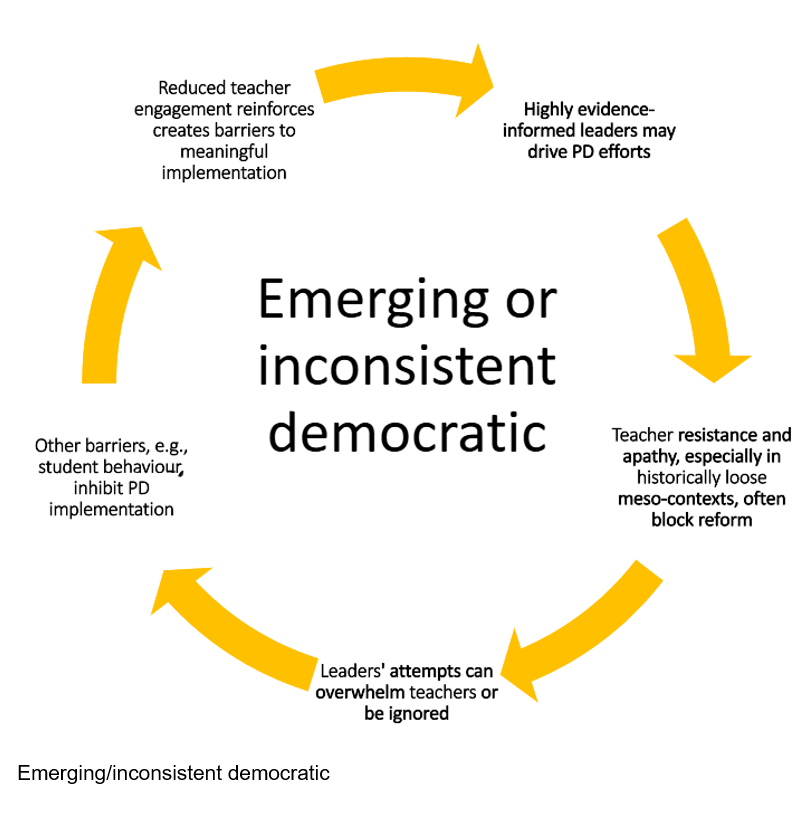
Inconsistent democratic vicious cycle stressors include:
- Fast paced change without reflection
- Too many initiatives at once
- Inappropriate, unsuitable interventions
- Poor past CPD experiences
- No de-implementation
If you want a virtuous cycle of teacher professional learning, PD implementation should look more like this:
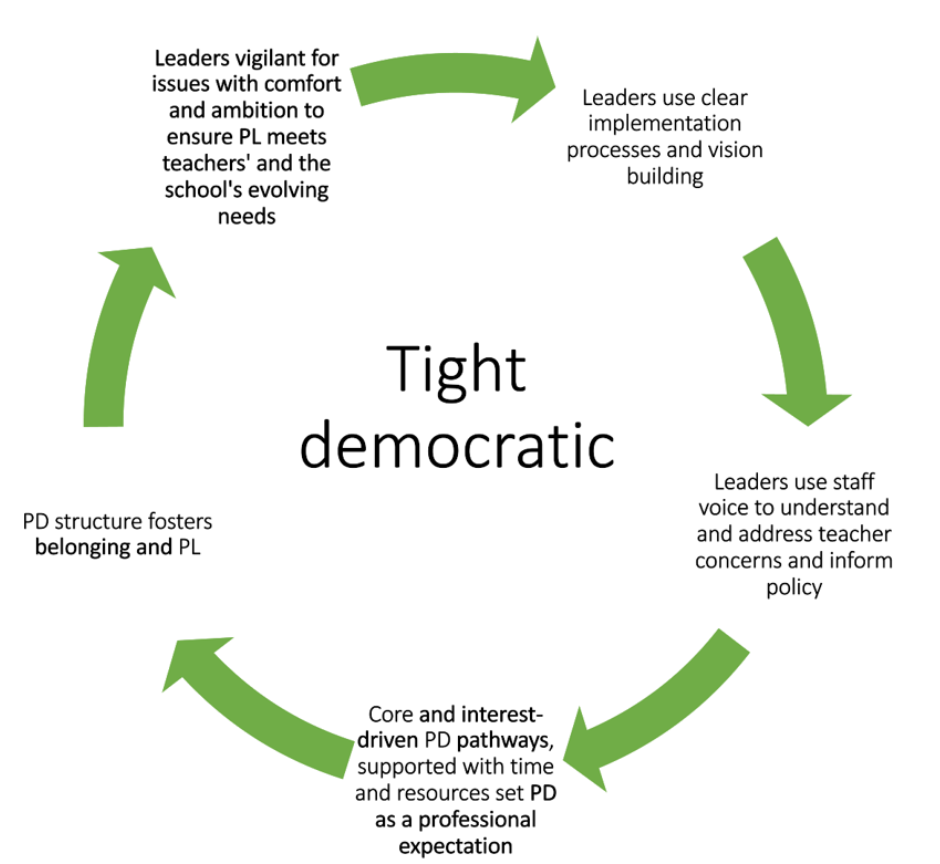
- Time to reflect and decide if/when to pivot – feeds policy
- Interventions meet school needs (curated choices)
- Deliberate contextualisation
- Reflection and coaching time an entitlement for all
- PD1 (content) and PD2 (contextualisation) time prioritised and protected
Waste teachers’ time at your peril.
It is essential to acknowledge that, for teachers, time wasted at school = time spent working at home.
Even the good, worthwhile stuff is hard to swallow after a busy day. The sooner the system flexes to allow for reflection and meaningful co-creation, and the PD diet is improved, the better off we will all be. Including the students, because this resentment trickles down.
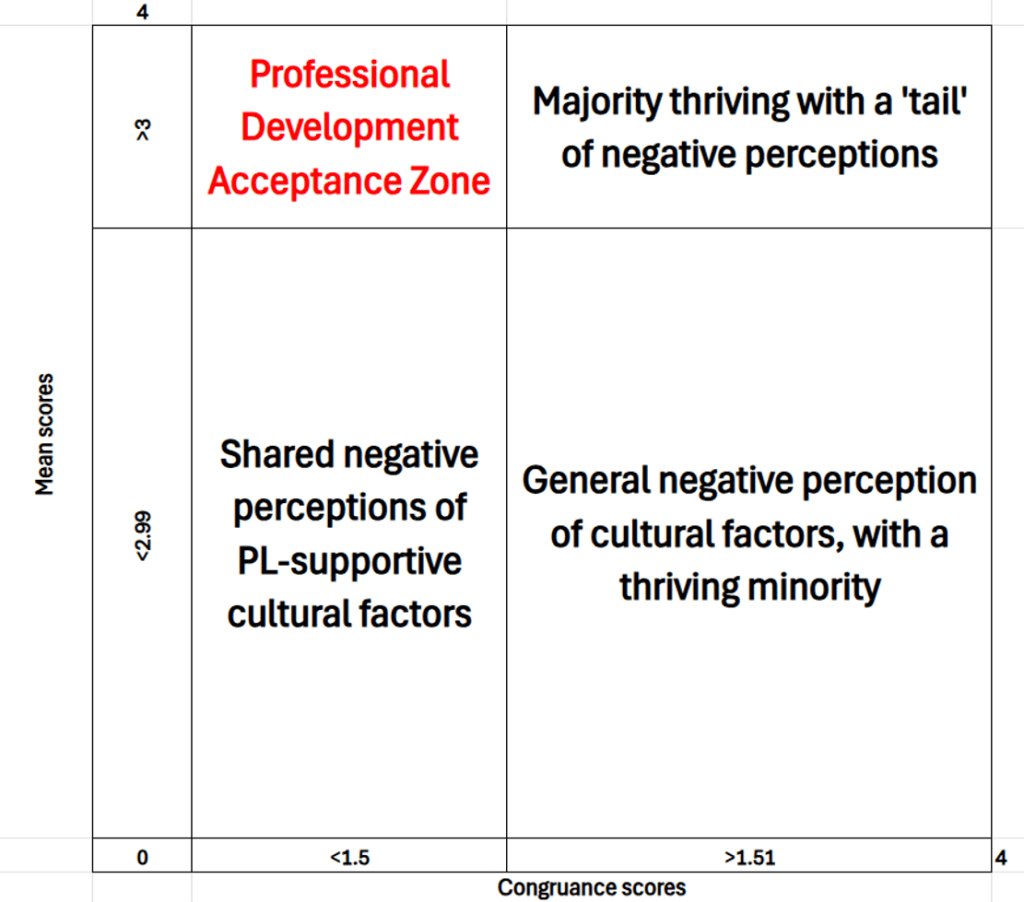
There is a sweet spot for teacher professional learning. This is the Professional Development Acceptance Zone (PDAZ) and it emerges in school cultures where teachers experience the cultural dimensions associated with growth and learning (agency, trust, efficacy, logistics, collegiality, resilience, reflexivity and professional autonomy) most consistently and strongly.
My research indicates a correlation between the ‘tight democratic’ implementation cycle and the numbers of teachers who experience the school’s culture in the PDAZ.
There is a relationship between high quality PD and teacher growth and wellbeing, and we constantly throw the opportunity to capitalise on it away.
‘Tight democratic’ implementation cycles are brilliant when they work, but they need maintenance. Otherwise they collapse into vicious ‘loose’ or ‘inconsistent’ cycles.
There are a couple of caveats to watch out for, even with ‘tight democratic’ cycles:
1. The management of ambition – it can be frustrating to be an efficient cog in a well oiled machine. Leaders need to notice those who need a bit more challenge to thrive and give them meaningful things to do.
2. The grit that makes the pearl – curate the diet of PD too tightly and risk group-think. There’s got to be space for people to bring in fresh ideas without detailing the system.
There’s a relationship between points 1 and 2!
All this leads to the question – What’s your school’s PD diet like? Are you perpetuating a vicious cycle with your provision? Which of these sounds familiar?
Cabbage soup – everyone is instructed to deliver a very narrow range of strategies in a tightly controlled way. Its punishing (and it stinks).
Junk food – Comprises a wide array of un-evaluated novelty initiatives that you can choose from without much follow-up. Fun at first but bad for you in the long run.
Ultra Processed – Fad, fad, fad. These initiatives are so far-removed from research-data and full of lethal mutations that no-one knows the long term effects on student outcomes (but we suspect they are not good).
One of your five a day – something from a curated selection of evidence-based options that you have the opportunity to research in your own context and evaluate.
Balanced diet – after a solid audit, a focus group pilots something your school leaders knows is needed and evaluates and contextualises it. Only then is the ‘five a day’ menu presented to staff over a series of sessions with built in feedback loops.
Mmmm, yummy!
We urgently need to understand teachers’ relationships with the CDP ‘diet’ and the culture we deliver it into. If we don’t, even the best delivered, most useful CPD in the world will continue to be rejected by some teachers.
Influencing the Professional Development Acceptance Zone (PDAZ)
 Exploring culture and professional learning
Leave a comment