

I don’t think that it is possible to over state how important Carl Hendrick’s post about the prevalence of lethal mutations of evidence-informed practice is (https://carlhendrick.substack.com/p/the-lethal-mutation-of-retrieval).
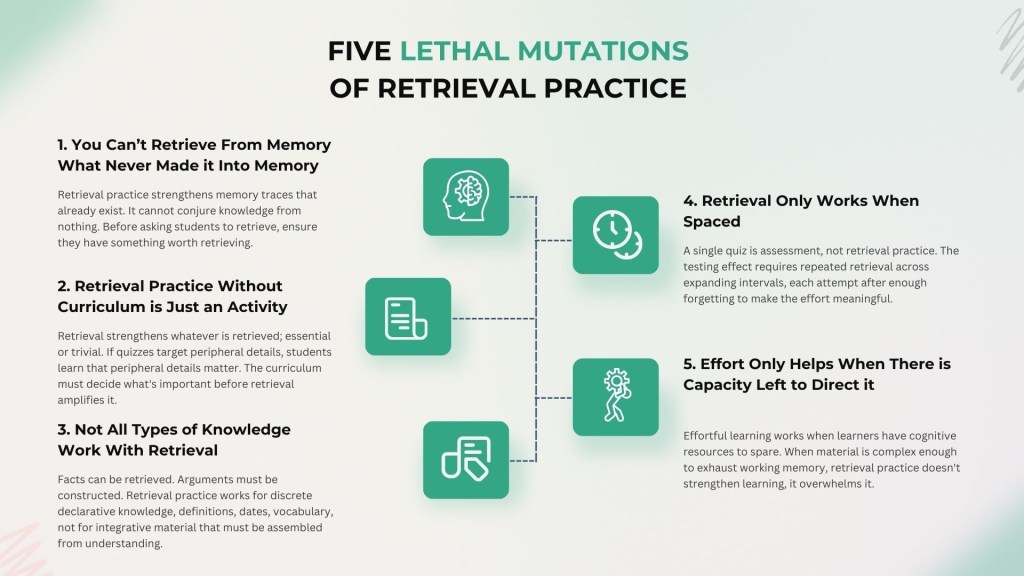
If retrieval practice is a ‘non-negotiable’ in your school and teachers are using it uncritically, I’m willing to bet that some of these lethal mutations are happening.
And I bet that everyone feels good about the widespread ‘evidence-informed practice’ that is going on across the school.
Leaders – you can tick that you have seen it on your checklist.
Teachers – you can confidently say you are using ‘best practice’.
As with most things, the evidence is MUCH more nuanced and the reality MUCH more complex.
The damage caused by uncritical, un-nuanced application of ‘silver bullet’ strategies is significant because:
a) If time is spent delivering strategies that don’t work, potentially powerful learning opportunities are missed. At best, this wastes valuable instruction time. This assumes that doing it badly is benign, which may not be the case because…
b) It can cause excessive and unnecessary cognitive stress to students. The opposite of what teachers intended. And yet teachers keep doing it because…
c) The teaching and learning policy turns teachers into performative transmitters of practices they have themselves received passively in transmissive CPD. They do it because they are told and because someone is going to check. They might face a sanction if they get caught out not doing it. This is not a good reason for someone to do anything, and it causes harm in the long term because…
d) It can inhibit teacher acceptance of future CPD (even if it is really good). When teachers don’t see the promised benefits, they become cynical and closed to future learning.
This is a vicious cycle.
I suggest that by opening up Professional Development to a two phase process, these potential pitfalls can be noticed and mitigated for. The two phases of effective PD are:
– PD1 – the content (what the evidence actually says)
– PD2 – the intentional protected time and space critical engagement needed for contextualisation, practice, evaluation and co-creation
In my EdD, I found a correlation between cycles of PD1 and PD2 in tight democratic cycles and teacher capacity for sustained professional learning.
If a strategy is worth implementing, it is worth doing properly.
 Exploring culture and professional learning
Leave a comment