
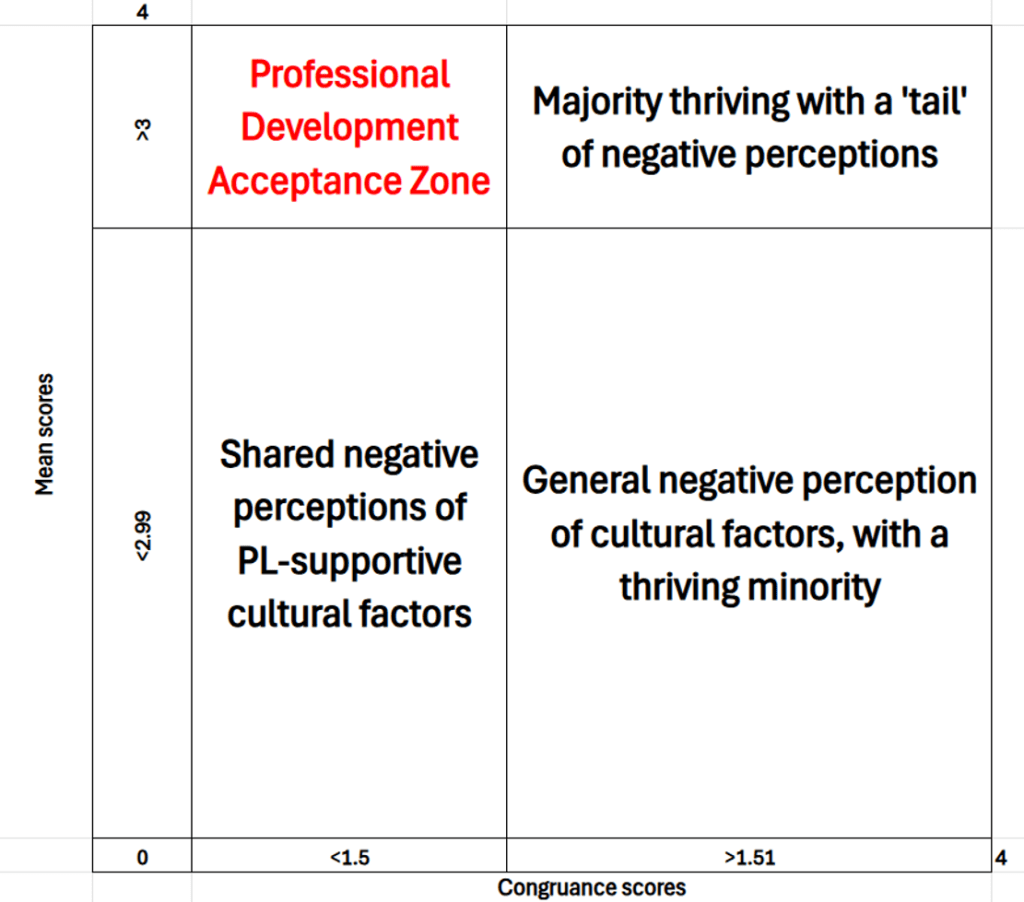
We all want to get people on board, bought in, aligned, on message and engaged. We all know this is harder than it sounds. My research suggests that we should start by understanding teachers’ perceptions of schools’ cultures for professional learning. How many indicators fall into the Professional Development Acceptance Zone (PDAZ)?
What is the PDAZ?
It is the sweet spot in a school’s culture where people are aligned in their positive perceptions of the dimensions that are associated with sustained teacher professional learning.
My thorough, systematic review of the literature in professional development and learning reveals that certain dimensions of organisational culture are associated with increased capacity for professional development and learning.
When I talk about teacher openness to PD, I mean that the sessions and content are accepted as relevant and useful. PL means that the attendee’s knowledge, attitudes, skills and behaviours change over time after engaging with PD.
My analytical framework which has been developed to capture the nuanced perceptions of key cultural dimensions:
- Agency
- Efficacy
- Logistics
- Collegiality
- Trust
- Resilience
- Reflection and reflexivity
- Professional Autonomy
I have analysed the way these terms are used and developed a framework that reveals a granular understanding of the nuance and sub-categories of these cultural dimensions. Capturing teachers’ perceptions through my innovative survey instrument reveals trends in a school’s culture for professional learning. When general perceptions of these dimensions are high (most people are happy) and cultural congruence is high (most people share a common perception of the culture), openness to PD increases leading to greater engagement over time and sustained PL.
So, what makes the difference?
Knowing where your organisation stands by understanding the patterns of perception of your culture for learning by mapping which PL supportive factors appear in the PDAZ is just the beginning of the story.
Curate your culture
You can curate and shape your organisational culture to shift more PL-supportive dimensions into the PDAZ. It helps to think about PD in two subcategories: PD1 and PD2. PD1 is the content being taught; the thing you want people to understand and enact. PD2 is the essential protected time in which teachers work together to process, contextualize and co-create how the intervention will work in practice in their context.
The importance of PD2
My research indicates that that the systematic presence of PD2 shifts more PL-supportive cultural dimensions into the PDAZ.
Simply put: The more systematic the PD2, the more cultural sub-dimensions showed up in the PDAZ.
My data suggests that there is no getting around the need for PD2; the schools where it was most systematically planned and protected had the highest scores for both teacher positive perceptions of culture for learning and congruence. In schools were PD2 was ‘looser’ and voluntary, mean perceptions might be high, but there was greater variance in perception – there was a disengaged ‘tail’ of teachers who were not having a good time, PL wise.
PD2 isn’t a silver bullet; shifting culture take time, but it does help. There are well established sociological reasons why PD2 works as a mechanism for culture curation. Giddens’ (1984) structuration theory offers a practical and theoretical understanding of the relationship between artefact generation and cultural shift. PD2 is an expression of this process in action. The key ideas here is that this process happens anyway – people will talk about your PD1 and change their behaviour in some way, but there are likely to be unintended consequences and negativity, and rejection talk can fester. PD2 enables you to influence (but not control!) the narrative.
PD2 and co-creation
PD2 is not managerialism, it’s a democratic process that you curate. Provide ‘best bets’, provide structures for reflection, ensure psychological safety and protect time and resources. But remain flexible with what the outcome looks like in practice. An intervention will look different in Art, Maths and PE.
Consistency isn’t the same as identikit, jelly-mould teaching. Give teachers the agency to engage deeply with the intervention and then respond with their professional judgement. Engage in robust discussions and be ready to really hear the responses. Take concerns seriously and move forward together.


 Exploring culture and professional learning
Leave a reply to Learning Anxiety vs. Survival Anxiety: What Really Drives Change in Schools? – Exploring culture and professional learning Cancel reply